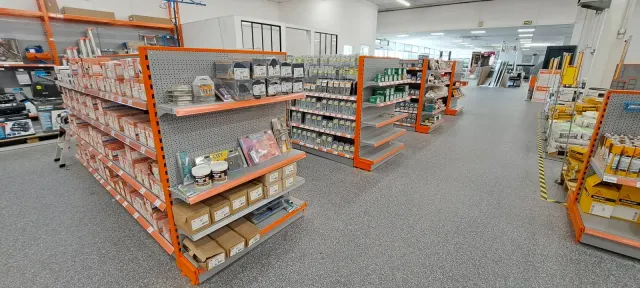
Store fittings

Wall Displays

The Store Fitting catalogue, printed pages 6–17, documents generic gondola components: plain, perforated, slatted, mesh and bar back panels, shelves, hooks and label holders. It publishes no universal wall-display sheet; layout, support, fixing, dimensions, load and accessories require model validation.

Free on-site audit and quote, anywhere in France, since 2004.

Wall Displays — DIY wall-display installation in a store

Pegboard or slatwall: which display system fits the product?

Pegboard suits hand tools, blister-packed accessories and products presented on hooks. Slatwall, also called a grooved panel, suits boxed or loose goods placed on shelves, baskets or clip-on supports. A combined module keeps hanging and shelved ranges together in one consistent wall run.

Capacity, sizing and visibility for a DIY wall display

The catalogue documents module widths of 665, 1,000 or 1,330 mm and shelf depths of 370, 470 or 570 mm. The right layout depends on product weight and format, sales rotation and the sightlines you need to preserve. Capacity is not universal: it is confirmed against the selected module, anchors and accessories.

Installation, maintenance and project checks

Before installation, the design office checks the wall substrate, anchors, levels, clearances and customer circulation in front of the run. Panels and accessories should be cleaned according to their finish, with a visual check of fixings, hooks and shelves when the range changes. No specific certification is claimed here without supporting evidence: load, safety and accessibility constraints must be confirmed for each layout.

Types and specifications — reference points to confirm

FeatureRange reference points
TypesPerforated panel, plain slotted wall, combined perforated + shelves
HeightDefined for the layout; no universal wall-display height is published
Module width665 / 1,000 / 1,330 mm in the Fitting catalogue
Load per moduleValidate by upright, console, depth, fixing and accessories; no universal module load is published
Wall and fixingsTo be studied against the wall substrate, anchors and selected configuration
AccessoriesSingle and double hooks, shelves, baskets, tool holders
FinishesExisting reference points: white, grey and black epoxy, RAL colours — confirm for the selected range

Use cases

Request a quote Download the catalog

See also

Frequently asked questions

What is a store wall display?

Store Fitting pages 6–17 show generic components, but no universal wall-display sheet. Layout, support, fixing, panel, accessories and dimensions require confirmation for the model.

Perforated panel or slotted wall: which to choose?

The perforated panel takes hooks and suits tools and blister packs; the slotted wall takes clip-on shelves, baskets and accessories for shelved goods. The combined version mixes both on one module.

What load can a wall display carry?

No universal wall-module load is published. Upright, console, depth, distributed load, support, fixing and accessories must be validated together; another system is selected only after this sizing.

What products belong on a DIY wall?

Hand tools on hooks, accessories and consumables on shelves, long goods on dedicated holders: the wall is ideal for a large number of product lines with shallow stock depth.

Does a wall display really free up sales floor?

This benefit depends on the plan and is not quantified in a universal product sheet. Height, footprint, aisles, product-line count and circulation must be compared on the plan for the selected model.

How should a wall display be sized and fixed?

Sizing starts with product weight, format, stock depth and sales rotation. The wall substrate, anchors, clearances and exact module load must be checked on the layout before installation.

How should pegboard or slatwall be maintained?

Clean the panel and accessories according to their finish, then visually check fixings, hooks, shelves and baskets whenever the range changes. The load and accessory condition must remain compatible with the installed system.

Which regulatory constraints should be considered?

Fixings, load, product safety and accessible circulation depend on the premises and layout. This page makes no specific certification claim without supporting evidence; applicable points must be confirmed during the design study.

Got a project? Let's talk about it!

Our experts support you from design to installation of your storage and layout solutions.

Let's talk about your project